When Awakening Hurts: 4 Things That Actually Help
If you are in pain right now and you do not know what to do with it, this is for you.
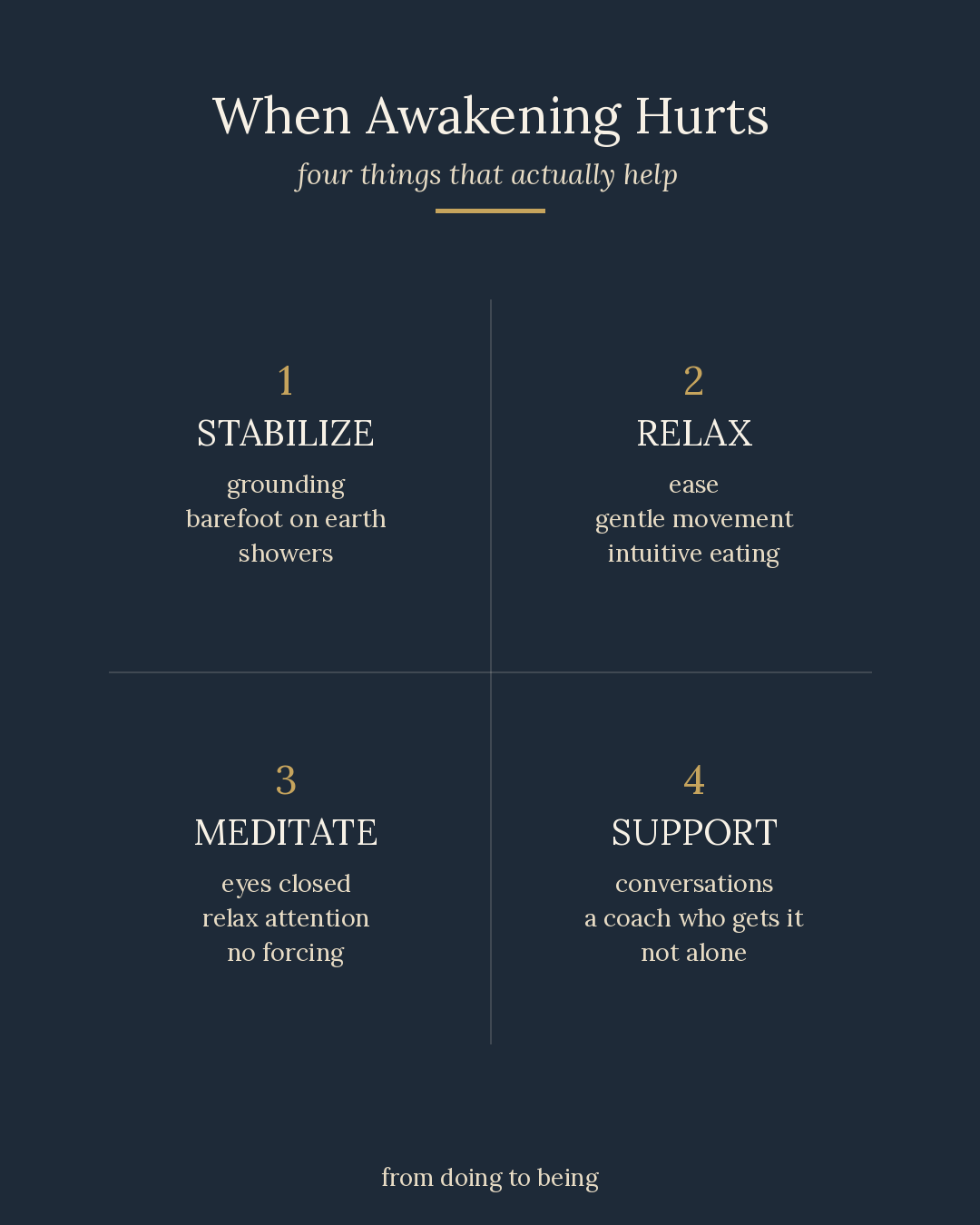
There are four things that help when an awakening process becomes painful. Not techniques to add to an endless list, but four directions you can move toward when the suffering feels like too much. I walk through these with almost every person I work with. They are not a checklist. They are a map.
Before anything else: if your suffering is intense or long-lasting, please also seek help from a doctor, psychologist, or psychiatrist. Not everything that feels like awakening is awakening, and there is no shame in getting proper support. What follows assumes you are moving through an awakening-related phase, whether that is a short one of a few days or a longer one of a few weeks. Be careful with yourself, and ask for help when you need it.
1. Stabilization
Stabilization means your nervous system knows that you are safe. Not knowing it mentally, but feeling it in the body. The nervous system does not respond to reassurance in words. It responds to sensation.
The main tool here is grounding. Stand barefoot on grass, or any earth, directly connected with the ground, for about ten minutes. Fifteen or twenty if you feel really ungrounded. If you are deeply overwhelmed, lie down in the grass. A shower works too. The point is to give the nervous system a direct physical signal that it is safe and held.
When someone comes to me making progress, with some relaxation in their life, but not feeling stable, this is almost always where we start. Grounding first. Everything else is harder to build on an unstable foundation.
2. Relaxation
When you are really suffering, the worst thing you can do is force yourself through a packed agenda. Forget the to-do list for a moment. Do only what is genuinely urgent or essential. Set the ambitions aside for now and bring in a level of ease.
This can look like eating intuitively, going with the flow, letting the body move where it wants to move, trusting that the timing of things does not all rest on your shoulders. It can also mean swapping your usual intense workout for a slow walk in the neighborhood or a sit in the park. Gentle movement instead of forced output.
Relaxation is the most underrated of the four, and often the one people resist most, because slowing down feels like falling behind. It is not. It is what allows everything else to integrate.
3. Meditation (the easy kind)
When I say meditation here, I do not mean forceful techniques or heavy shadow work. During a painful phase, that is exactly what you do not want. The suffering you are experiencing is a form of tension, and you do not release tension by adding more tension.
What helps is easy meditation. Sit, close your eyes, and above all, relax your attention. Do not force a particular shift or outcome. When you notice the thoughts, the feelings, or the energy in the body, meet them with relaxed attention rather than effort. Keep the body relaxed. Keep breathing. Bring ease to the tension instead of fighting it.
If you are feeling strong energetic activity, like kundalini, the instinct is to tense up against it. Do the opposite. Relax the body. Stay grounded. If you feel yourself getting ungrounded during the meditation, bring your attention down to your feet.
The shift here is from trying to release the pattern yourself to letting the pattern release itself while you hold space for it.
4. Support
When you are going through suffering, you need support. Often this is simply conversation. Sometimes it is someone bringing you food. Mostly it is having people you can actually talk to.
That can be friends and family. It can also be a teacher, a coach, or a therapist, and it is worth understanding the difference. A teacher tends to give you theory, telling you what to do in principle. A coach looks at your specific situation, builds a custom plan with you, and matches the advice to the phase you are actually in. A therapist often works more slowly, asking questions and drawing things out of you rather than offering direction.
Each has a place. The difficulty in an awakening process is that a teacher's general teaching is hard to fit to your specific situation, and many therapists are simply not equipped to understand awakening, kundalini, and spirituality. If you are going through this, it matters to have someone who actually understands what is happening to you.
For some people, support also includes a relationship with something larger. A conversation with God, with source, with a master or teacher who is no longer physically here, whether that is Jesus or someone else. If that resonates with you, lean into it. If it does not, leave it out. There is no requirement here.
How to use this
If you are suffering right now and wondering how to actually work with this, do this. Look at your suffering and score yourself honestly across the four. How much am I relaxing while I suffer, or am I forcing myself through? How much real support and conversation am I getting? How much easy meditation am I doing, where I let the pattern dissolve itself rather than trying to force it out? How stable and grounded do I actually feel?
Wherever the lowest score is, that is usually where to move next.
If you want help figuring out which direction you need right now, you can book a free call with me here, and we will make a custom plan for the suffering you are going through: https://calendly.com/keesblok/gratis-kennismaking?month=2021-03
Make it stand out
Whatever it is, the way you tell your story online can make all the difference.